
КАТЕГОРИИ:
Архитектура-(3434)Астрономия-(809)Биология-(7483)Биотехнологии-(1457)Военное дело-(14632)Высокие технологии-(1363)География-(913)Геология-(1438)Государство-(451)Демография-(1065)Дом-(47672)Журналистика и СМИ-(912)Изобретательство-(14524)Иностранные языки-(4268)Информатика-(17799)Искусство-(1338)История-(13644)Компьютеры-(11121)Косметика-(55)Кулинария-(373)Культура-(8427)Лингвистика-(374)Литература-(1642)Маркетинг-(23702)Математика-(16968)Машиностроение-(1700)Медицина-(12668)Менеджмент-(24684)Механика-(15423)Науковедение-(506)Образование-(11852)Охрана труда-(3308)Педагогика-(5571)Полиграфия-(1312)Политика-(7869)Право-(5454)Приборостроение-(1369)Программирование-(2801)Производство-(97182)Промышленность-(8706)Психология-(18388)Религия-(3217)Связь-(10668)Сельское хозяйство-(299)Социология-(6455)Спорт-(42831)Строительство-(4793)Торговля-(5050)Транспорт-(2929)Туризм-(1568)Физика-(3942)Философия-(17015)Финансы-(26596)Химия-(22929)Экология-(12095)Экономика-(9961)Электроника-(8441)Электротехника-(4623)Энергетика-(12629)Юриспруденция-(1492)Ядерная техника-(1748)
Modulation and demodulation
|
|
|
|
Digital signals from the data compression encoder are unsuitable for direct transmission to the telephone network. For 9.6kbit/s the necessary transmission frequencies extend from d.c. to 4800Hz, too wide for the telephone networks nominal bandwidth of 300Hz to 3000Hz. For transmission the digital signals are transformed by the modem to analogue voice band signals which can tolerate the frequency shift, noise, amplitude and group delay variation with frequency, and also the echo and phase jitter of the international telephone network. G3 line signals are analogue. They vary in amplitude as a speech signal, but they are generated from digital signals and may be completely and accurately recovered providing line conditions permit.
60.4.3.1 G3 signal transmission
G3 is a half duplex transmission which uses 2 types of modulation/demodulation; the first of 300bit/s for the T.30 protocol and handshaking between terminals. This 300bit/s V.21 modem is a robust FSK transmission. It is easily implemented and does not require training. It is used for the relatively low volume of data establishing machine parameters and providing feedback from receiver to transmitter.
The second is the high speed modem used for the compressed image data transfer. In G3 there is a basic V.27 mode of 4.8kbit/s with 2.4kbit/s fallback where the lines are poor, and optional modes up to 9.6kbit/s and up to 14.4kbit/s for use where terminals and networks permit. It is generally acknowledged that over 80% of transmissions used these higher rates.
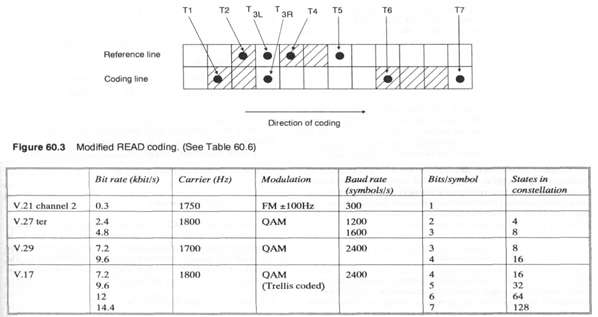
Table 60.7 compares the G3 modulation methods, where QAM refers to quadrature amplitude modulation.
60.4.3.2 Modem operation
The data rate modem takes a number of bits of the incoming data (e.g. 4 bits for V.29 9.6kbit/s), and for the symbol time (1/2400 second for V.29 9.6kbit/s) generates the relevant modulation condition for these bits (16 conditions for V.29 9.6kbit/s).
The modulation condition may be generated by a controlled combination of sine and cosine modulated carriers which are then filtered before application to the network to limit damaging out of band signals. The receiving modem tracks the carrier to correct for network frequency shift and recovers the symbol timing. It then studies the signal during this symbol period to decide which of the possible states the received signal most closely matches and decodes that state to provide the digital bit stream.
 |
To establish the symbol timing, and allow the receive modem to set equaliser conditions to compensate for the network impairments, an initial training signal is sent from the transmit modem. In G3 this is followed by a 1.5s period all '0' TCF, so that the machine can decide if it can correctly receive at this rate. If not the 300bit/s handshake reply initiates a new training sequence, which the transmitter may choose to send at a lower rate. With ECM it is often found desirable to operate at the higher data rates, accepting that a limited number of errors which can be rapidly corrected may provide an overall increase in transmission efficiency.
60.4.3.3 14.4kbills option
The CCITT option at 14.4kbit/s uses V.I7 TCM (Trellis Coded Modulation). The symbol rate is the same as V.29 9.6kbit/s which appears optimum for the telephone network, but the bits per symbol increase not to 6 as expected but to 7 to allow FEC (Forward Error Correction) data to be included. The 7th bit, bringing the number of states to be decoded at the receiver to 128, is generated from 2 of the data bits in each symbol interval. This introduced redundancy means that only certain decoded sequences are valid. The receiver knows from the recent signal history when an unlikely condition occurs and can make an educated guess at the correct data. It is this difference in operation which gives a 3dB signal/noise improvement in Gaussian noise tests, and noticeable end to end improvement over QAM in actual use.
1 Learn the words & word combinations:
| a manageable load | управляемая загрузка |
| multiple | множество |
| adjacent | соседний |
| appropriate | соответствующий |
| previous | предыдущий |
| remainder | остаток |
| permit | позволять |
| reference | ссылка |
| robust | надежный |
| relevant | соответствующий |
| reply | ответ |
| valid | действительный |
| advise | советовать |
2 Find Russian equivalents; mind the meaning of these expressions:
| ü for online signal processing | ü CCD single line image sensor |
| ü single line sensor assembly | ü multiple lens assembly |
| ü raster images | ü appropriate scanning time |
| ü an end of line code | ü redundant data |
| ü data compression encoder | ü group delay variation |
| ü data establishing machine parameters | ü sine and cosine modulated carriers ü the symbol timing |
| ü redundancy means |
3 Find English equivalents:
| ü способный | ü термическая головка |
| ü теплочувствительная бумага | ü заботиться |
| ü независимый | ü близко |
| ü почти приведены в контакт с бумагой | ü отверстия ü позволить |
| ü предыдущий | ü сдвиг |
4 Answer the questions:
1 How does a typical CCD scanner work?
2 What is a second popular method of scanning?
3 Explain the process of modulation & demodulation?
|
|
|
|
|
Дата добавления: 2015-03-31; Просмотров: 462; Нарушение авторских прав?; Мы поможем в написании вашей работы!