КАТЕГОРИИ:
Архитектура-(3434)Астрономия-(809)Биология-(7483)Биотехнологии-(1457)Военное дело-(14632)Высокие технологии-(1363)География-(913)Геология-(1438)Государство-(451)Демография-(1065)Дом-(47672)Журналистика и СМИ-(912)Изобретательство-(14524)Иностранные языки-(4268)Информатика-(17799)Искусство-(1338)История-(13644)Компьютеры-(11121)Косметика-(55)Кулинария-(373)Культура-(8427)Лингвистика-(374)Литература-(1642)Маркетинг-(23702)Математика-(16968)Машиностроение-(1700)Медицина-(12668)Менеджмент-(24684)Механика-(15423)Науковедение-(506)Образование-(11852)Охрана труда-(3308)Педагогика-(5571)Полиграфия-(1312)Политика-(7869)Право-(5454)Приборостроение-(1369)Программирование-(2801)Производство-(97182)Промышленность-(8706)Психология-(18388)Религия-(3217)Связь-(10668)Сельское хозяйство-(299)Социология-(6455)Спорт-(42831)Строительство-(4793)Торговля-(5050)Транспорт-(2929)Туризм-(1568)Физика-(3942)Философия-(17015)Финансы-(26596)Химия-(22929)Экология-(12095)Экономика-(9961)Электроника-(8441)Электротехника-(4623)Энергетика-(12629)Юриспруденция-(1492)Ядерная техника-(1748)
Our Place in the Universe
|
|
|
|
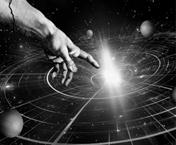 In our everyday life we encounter objects of widely differing sizes. Some of them are as large as a barn and others are as small as a pinhead. When we go beyond those limits, either in the direction of much lager objects or in the direction of much smaller ones, it becomes increasingly difficult to grasp their actual sizes. We know that mountains are very large, but at a distance they look quite small. While at a short range we can see but a few rocks and cliffs. We know that bacteria are very small, but to see them we have to use a microscope, through which they look quite big.
Objects that are much larger than mountains, such as our Earth itself, the moon, the sun, the stars, and stellar systems, constitute what we know as a macrocosm (i.e., “large world” in Greek). Very small objects such as bacteria, atoms, and electrons belong to the microcosm (i.e. “small world” in Greek). If we use the standard scientific unit, a centimeter (0.3937 inch), for measuring sizes, objects belonging to the macrocosm will be described by very large numbers, and those forming the microcosm by very small ones. Thus, the diameter of the sun is 139,000,000,000 cm, while the diameter of a hydrogen atom is only 0.0000000106 cm. Scientists customary express such numbers in terms of positive and negative powers of ten, and write 1.39 x 1011 cm for the diameter of the sun and 1.06x10⁻⁸ cm for the diameter of a hydrogen atom. Sometimes special very large or very small units are used. Thus, in the macrocosm we use the so-called astronomical unit (symbol: A.U.), which is defined as the mean distance of the earth from the sun and is equal to 1.4964 x 1013 cm, or a still larger unit known as a light-year (symbol: l.y.) which is defined as the distance traveled by the light in the course of one year and is equal to 9.463 x 1017 cm. In the microcosm we often use microns (symbol: m), defined as 10-4 cm, and Angstroms (symbol: A), defined as 10-8 cm.
It is interesting to notice that the size of the human head is just about halfway between the size of an atom and the size of the sun, or halfway between the size of an atomic nucleus and the diameter of the planetary system (on the logarithmic scale in both cases, of course).
Similar vast variations will be found in the time intervals encountered in the study of the macrocosm and microcosm. In human history we ordinary speak about centuries; in geology the eras are usually measured in hundreds of millions of years, while the age of the Universe itself is believed to be about 10-20 billion years. The revolution period of an electron in the hydrogen atom, on the other hand, is 10-15 sec, and the oscillations of particles constituting atomic nuclei have a period of only 10-22 sec. Notice that the wink of an eye is just halfway between the age of our stellar system and the rotation period of an electron in an atom. Thus, it seems that we are located pretty well in the middle between the macro- and microcosm and can look up at the stars and down at the atoms with an equal degree of infer- and superiority.
|
|
|
|
|
Дата добавления: 2015-01-03; Просмотров: 409; Нарушение авторских прав?; Мы поможем в написании вашей работы!