КАТЕГОРИИ:
Архитектура-(3434)Астрономия-(809)Биология-(7483)Биотехнологии-(1457)Военное дело-(14632)Высокие технологии-(1363)География-(913)Геология-(1438)Государство-(451)Демография-(1065)Дом-(47672)Журналистика и СМИ-(912)Изобретательство-(14524)Иностранные языки-(4268)Информатика-(17799)Искусство-(1338)История-(13644)Компьютеры-(11121)Косметика-(55)Кулинария-(373)Культура-(8427)Лингвистика-(374)Литература-(1642)Маркетинг-(23702)Математика-(16968)Машиностроение-(1700)Медицина-(12668)Менеджмент-(24684)Механика-(15423)Науковедение-(506)Образование-(11852)Охрана труда-(3308)Педагогика-(5571)Полиграфия-(1312)Политика-(7869)Право-(5454)Приборостроение-(1369)Программирование-(2801)Производство-(97182)Промышленность-(8706)Психология-(18388)Религия-(3217)Связь-(10668)Сельское хозяйство-(299)Социология-(6455)Спорт-(42831)Строительство-(4793)Торговля-(5050)Транспорт-(2929)Туризм-(1568)Физика-(3942)Философия-(17015)Финансы-(26596)Химия-(22929)Экология-(12095)Экономика-(9961)Электроника-(8441)Электротехника-(4623)Энергетика-(12629)Юриспруденция-(1492)Ядерная техника-(1748)
West South East
|
|
|
|
Slavic

___________ _________ ___________
 The history of Russia dates back to the ancient times. It is unique and full of paradoxes. Russia has always suffered from unexpected invasions from the West, South, and East, internal problems connected with impostors constantly trying to take advantage of Russia, its treasures and people. And, of course, Russia itself was a bit backward, in some ways it was always deaf to the civilization coming from the West. Red tape and stubborn officials tried to slow down progress and culture. But, on the other hand, there were a lot of celebrities, who enjoyed popularity and gained reputation as highly educated and gifted people. Russia is proud of them: they are great musicians, scientists, poets and many others.
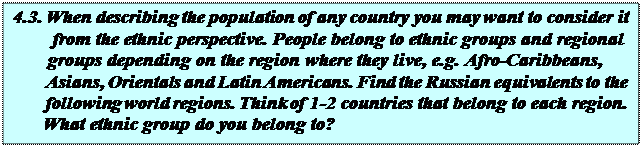 The Arctic The Far East
North America The Middle East
The Caribbean Asia
Latin (South) America The Pacific
The Atlantic North Africa
Scandinavia Central Africa
Europe Southern Africa
Australasia The Indian Ocean
 The Antarctic
With –ish: British Irish Flemish Turkish Spanish
With –(i)an: Canadian Brazilian American Russian Australian
With –ese: Japanese Chinese Guyanese Burmese Maltese Taiwanese
With –i: Iraqi Kuwaiti Pakistani Yemeni Bangladeshi
With –ic: Arabic Icelandic
 Special forms: French Greek Swiss Dutch
Scotland, Hungary, Argentine, Wales, Italy, Indonesia, Sweden, Norway, Finland, Bulgaria, Poland, Ukraine, Mexico, Germany, Portugal, Congo

 1. What are the main ethnic groups in Russia? The USA? Great Britain?
2. Which countries, strictly speaking, are located in Scandinavia?
3. What are the five countries with the highest population?
4. How many languages are there in the world?
5. Where is Kiribati?
6. Where do people speak Inuit?
7. What are the five most widely spoken languages?
 (a) Arab and Arabic
(b) Scottish and Scotch
(c) Oriental and Occidental
 Russia has one of the widest varieties of ethnic groups in the world (over 160 ethnic groups according to 2002 All-Russian Population Census), but ethnic Russians form the vast majority of the population (79.8%). In 2002 the non-Russian population constituted only 20% of the total, with the largest minority, the Tatars, making up only 3.8%. Ukrainians (2%), the Chuvash (1.1%), and Bashkirs (1.2%) are the only other minorities constituting more than 1% of the population. Other minorities include Chechens, Armenians, Mordovians, Belarusians, Germans, etc. Thirty-two ethnic groups have their own administrative territories. Thousands of people have left ethnic administrative territories in recent years. Although Birobijan (Jewish Autonomous Region) was originally created for the Jewish people of the Soviet Union, it has never been a major area of Jewish settlement; emigration in the post-Soviet era has caused its Jewish population to become even smaller.
The Russian language is the country’s official language and it is the most commonly spoken in business, government, and education. Ethnic Russians speak their native tongue almost exclusively, though most Russians living in the areas of other ethnic groups can speak the ethnic language as well. People belonging to other nationalities and ethnic groups are bilingual. More than 100 languages are spoken in Russia. Some of the ethnic republics have declared official regional languages, but millions of non-Russians have adopted Russian as their mother tongue. Among the most bilingual are the Ingush people.
During the Soviet era the Soviet government helped many smaller ethnic groups develop their own alphabets and vocabularies. At the same time the USSR’s educational policies ensured widespread use of the Russian language.
 most of the people or things; a group of people of a different race or religion than most people in the country; language; an official count of all the people in a country; able to speak two languages equally well; to start to use a particular method, language, etc.
 Russia inherited a well-developed, comprehensive system of education from the Soviet period, with an extensive network of preschool, elementary, secondary, and higher educational institutions. Enrollment in preschools, which is optional, has dropped since the Soviet period, as tuition became more expensive after 1991. Free, compulsory education begins at the age of 6, when children enter primary school for an intensive course of study from grades one to four. Intermediate education begins with grade five and continues through grade nine. Children can then enter upper-level schools or vocational-technical programs, which include on-the-job training. The majority of students are instructed in the Russian language, and General Certificates of Secondary Education as well as diplomas are granted only in Russian, Bashkir, and Tatar. Other non-Russian languages are taught to various degrees, usually only for the first few years of instruction.
Undergraduate training in higher educational institutions generally involves a four- or five-year course of study, after which students may enroll in a one- to three-year program of graduate training. In the mid-1990s about 4.5 million students were enrolled in Russian institutions of higher education. Graduate students who successfully complete their courses of study, comprehensive examinations, and the defense of their dissertations receive candidate of science degrees, which are roughly equivalent to doctoral degrees in the United States. A higher degree, the doctor of sciences, is awarded to established scholars who have made outstanding contributions to their disciplines.
Since 1991 the system of higher education has undergone considerable changes. Private schools, some operated by religious organizations, have opened in large numbers. Public institutions of higher education, once heavily supported by the state, have had to cover a much larger share of their operating costs. In order to attract support from potential sponsors, regional authorities upgraded more than 100 teacher-training colleges to universities or academies, which are more prestigious. As a result, new teacher-training institutes were created to ensure that Russia trains an adequate number of future educators.
The most prominent Russian universities are Moscow State University, Saint Petersburg State University, Kazan’ State University, and Novosibirsk State University. Other important universities are located in Rostov-na-Donu (Rostov-on-Don), Nizhniy Novgorod, Tomsk, Vladivostok, and Voronezh. In addition to universities and institutes, Russia has one of the world’s foremost organizations devoted to scholarly research, the Russian Academy of Sciences.
 state terms seminar degree co-educational academic
private primary tutorial graduate nursery school fees
grant secondary lecture break up compulsory
When children are two or three years old, they sometimes go to a (a) ______, where they learn simple songs and games. Their first real school is called a (b) ____ school. In Britain children start this school at the age of five. The (c) ____year in Britain begins in September and is divided into three (d) _____. Schools (e) _____ for the summer holiday in July. (f) ____ education begins at the age of about eleven, and most schools at this level are (g) _____, which means boys and girls study together in the same classes. In Britain education is (h) ____ from five to sixteen years of age, but many children remain at school for another two or three years after 16 to take higher exams. Most children go to (i) ____ schools, which are maintained by the government or local education authorities, but some children go to (j) ____ schools, which can be very expensive. University courses normally last three years and then students (k) _____, which means they receive their (l) ____. At university, teaching is by (m) _____ (= an individual lesson between a teacher and one or two students), (n) ____ (= a class of students discussing a subject with a teacher), (o) ____ (= when a teacher gives a prepared talk to a number of students) and of course private study. Most people who receive a university place are given a (p) ____ by the government to help pay their (q) ___ and living expenses.

(a) to sit an exam and to set an exam
(b) to take an exam and to pass an exam
(c) compulsory and voluntary
(d) to educate and to bring up
(e) a pupil and a student
 up to of at by from in into
1. Which school do you go ______?
2. He left school _____ the age _____ 18.
3. The summer term ends _______ July.
4. She’s not at home, she’s _________ school.
5. She goes ________ Sussex University.
6. His lecture was divided _____ four parts.
7. School breaks ___ next Friday.
8. He is now _____ university.
9. She is _____ the same class as her brother.
10. Students usually receive a grant ____ the state.
11. They’re given a grant ____ the state.
 (a) pro- and anti-
(b) an election and a referendum
 election campaign support polling day opinion poll vote polling station predict ballot box candidate
People sometimes try to (a)____the result of an election weeks before it takes place. Several hundred people are asked which party they prefer, and their answers are used to guess the result of the coming election. This is called an (b)_____.
Meanwhile each party conducts its (c)____with meetings, speeches, television commercials and party members going from door to door encouraging people to (d)____their party. In Britain everyone over 18 is eligible to (e)____. The place where people go to vote in an election is called a (f)____and the day of the
election is often known as a (g)____. The voters put their votes in a (h)____and later they are counted. The (i)____with the most votes is then declared the winner.
 cabinet alliance right-wing prime minister one-party states
|
|
|
|
|
Дата добавления: 2014-12-27; Просмотров: 1129; Нарушение авторских прав?; Мы поможем в написании вашей работы!